Symptom:
You have inserted a huge number of records using the InsertOnSubmit(row) call, and you have ran out of memory in your .NET program using LINQ TO SQL technique.
Cause
The DatabaseContext caches all previously inserted rows.
Solution
There are many articles on the net using the Reflection locate the internal ClearCache then call it. This is not the intended use of the DatabaseContext object. It is a light-weight object and thus, you should simply dispose a object and create a new one. In my situation after a few thousand consecutive insertions, I dispose (i.e., new the object into the variable previously held the old context object.) This is also significantly more efficient way of clearing the cache held.
Tuesday, April 12, 2011


Friday, February 11, 2011
Installing Drupal 7.0 Experience on Joyent SmartMachine
This is a quick note to myself regarding the installation of Drupal 7 on Joyent SmartMachine
- Creating the database and user is done from the Webmin->Servers->MySQL_Database_Server. Be sure that the you give the select, create, drop and insert permission to the mySQL user that you will give to Drupal
- SSH Login as the admin user then sudo bash
- The content of the drupal tar goes into /home/
/web/public so in other words in that directory, you should have install.php - PDO may be disabled (it was in my case). To enable it, edit /opt/local/etc/php.ini and uncomment pdo.so and pdo_mysel.so uncomment to mean to remove the semicolon.
- From the shell reboot the machine by tying in "reboot" This will activate the PDO (there are other ways to do this, this is one of the quick ways to do it.)
Sunday, February 06, 2011
Annoyed by: System.Xml: The node to be inserted is from a different document context?
Symptom:
You try to copy one or more XML Nodes (usually elements though) from one XMLDocument and another, and you get the following error:
Hope I gave you enough hint here, but if you need a more complete coding example, please post a comment and next time I come back here I will write one up for you.
You try to copy one or more XML Nodes (usually elements though) from one XMLDocument and another, and you get the following error:
System.Xml: The node to be inserted is from a different document context.
My Fix, Hint:
(Note from 1/21/2012: Try using the XDocument class and LINQtoXML, it's much easier to deal with!)
(Note from 1/21/2012: Try using the XDocument class and LINQtoXML, it's much easier to deal with!)
There is an official way to fix this using clone, import and InsertBefore or After. But that's too difficult to figure out, in my case I still get the above mentioned exceptions. I often do not know which node to insert (you are supposed to find the parent node then insert) or afraid to insert something at a wrong node level.
Rather than wasting a whole lot of time, I do this entirely in text using StringBuilder and such. You will find the following methods very handy.
XmlNode.OuterXML
- This contains the Text representation of XML including the node itself and all of the children.
XmlNode.InnerXML
- This contains the Text representation of XML node of all its children.
You know that you can build up a string using StringBuilder.Append(string) you can form the basis for the new XML document which some of the node data copied from another XML document WITHOUT having any issues with copies being prohibited between two documents.
As an added bonus, you can see exactly the new XML document being formed since it is in the string form.
Once you form the destination XML, there is a handy function LoadXML(string), and you are back to have the new XMLDocument. There absolutely is no need to create a StringReader or stream of any kind.
XmlDocument xd = new XmlDocument();var sx = sDoc.ToString();xd.LoadXml(sx);
Hope I gave you enough hint here, but if you need a more complete coding example, please post a comment and next time I come back here I will write one up for you.
Thursday, August 19, 2010
Notes on Amazon EC2 Image Creation Fails for Windows Machines
Disclaimer:
- This is my notes on the topic and not necessarily a complete solution. In fact, probably it contains some very inaccurate information (but you can help to rectify this via your comments.)
- This article also pertains to EBS Backed Windows EC2 running instances.
Obviously I have tried this with varying degree of success and information on this is scattered around the Amazon AWS forums and on the web. The most common of the errors would be that the Image creation begins and then after a long while it says "Failed" but without much explanations why. Some people on the net are saying the success rate is 40%. I was actually relieved to find this because I thought it was just me that's suffering this much failure rate!
The Amazon documentation is not very clear to me as to what and how to do these things. It seems to require you have gained some more "under-the-hood" knowledge of this. And as a just a casual user of the system I expect that I should not need to learn everything to use it.
In addition to that as a "basic" user, I don't get any direct support from Amazon. That's at least $100/mo or much more for silver or gold support privilege even in these kind of the situations when the failure (even just to explain what to do) is on their side.
I also highly suggest you install Elasticfox on your browser. Since the following descriptions will be based on how I'd do things on Elasticfox.
My Findings on Creating a Copy of Running Image
- To do this on Elasticfox, go to the Instances list, right click and select Create Images (AMI) item.
- Many people reported that when creating a copy from the running image, it will stop and restart the instance. This does happen. Worse yet, it will be stopped for the entire duration of when it is taking the snapshot, depending, this could be 10s of minutes. You'd probably want to schedule a down time. I should have done this just as soon as I have created the initial instance before went into production. Elasticfox does have a menu item not to reboot the instance I have not yet tried this.
- Some people say it has to be a Running instance, but that seems to be not true. I can image from a stopped instance as well and I have made images successfully this way via Elasticfox. In fact, that has more success rate than doing it on a running instance.
Some of The Issues I Have Discovered That Cause Failures
- Again, copying the running instance will cause a restart, so be prepared for the downtime.
- If you have already stopped the instance, it is at least more likely the imaging will succeed. A few caveats on this are that, at least in my case, the Elastic IP will get disassociated with the instance as shutting down the instance will detach the Elastic IP (wish they did not, at least for a short time), and also the machine's local addresses will change after restarting. This means that if you are locally pointing systems, for example, SQL, then the that address have to be re-configured in each application.
- Processes like SQL or other high I/O or CPU consumer items should be stopped. In fact, you should pare down the services to essentials (like SQL, agents, browser etc.) before taking the image copy. The one exception to this is not to stop the Amazon's EC2 services that came with the original Windows image whichever they exist.
- If you have other volumes mounted that also leads to a failure. Stop all services and applications you don't need to be running then dismount any "drives" and then make the image copy. This seems not be an issue if you are imaging a stopped instance.
Well, good luck and if you find this article correct or wrong, please let me know in the comments so that I can actually improve it.
Wednesday, August 18, 2010
IIS 6: Installing Duplicate Certificates to Multiple IIS 6 Servers For Server Farm Implementation
Symptom:
You have more than one servers that are hosted through a load-balanced router. The external address is assigned to (obviously) a single Fully Qualified Domain Name (FQDN). You want to install the same server certificate that represents the same domain name across all your IIS 6 based servers.
Procedure:
First off, yes you can do this. The procedure is very clearly explained in this Microsoft article:
Just in case we lose above article, here is the gist of how it is done.
- Request and install the cert on the first server as you would normally do. Don't do the request from other servers, if you do, remove any pending cert requests.
- Open the MMC and add the Certificate module.
- Open the Computer Account then Personal certificate folder.
- Navigate down to the Web Certificate you want to export.
- Right click tasks and Export.
- In the wizard select to include the Private Key and include all certificates in the path in the next page.
- Copy the exported result to another server
- Do the same MMC stuff
- Import the stuff you exported into the Personal store
- From the IIS certificate section of the Directory Security, do the "Assign an Existing Certificate"
That's basically all you need to do.
Getting an XmlNode (or XmlElement) Out of XPathNodeIterator (C#)
Symptom:
You have a code you iterate through a group of Xml Nodes (for most people that's XmlElement). You have however noticed that once you get to a specific spot, there is no easy way to perform the complete node operations against the iterator since Casting of the iterator to XmlElement results in a compilation error.
So, you cannot cast the Current of the iterator like
XmlNode node = (XmlNode) i.Current;
(I really think this is a poor design myself since it goes against all our intuition.)
Solution:
Well, there actually is a way to "cast" this to an element, but the syntax is a bit more involved.
XmlNode node = ((IHasXmlNode) i.Current).GetNode();
Or in most cases you can cast this to XmlElement by
XmlElement node = (XmlElement) ((IHasXmlNode) i.Current).GetNode();
Get a Permission Error When Creating A New Scheduled Task
Symptom:
You tried to create a new Scheduled Task on Windows XP (may be other version of Windows) and you get a Permission Denied error even though you are logged in as the local administrator.
Fix:
The Schedules are stored under C:\Windows\Tasks Unfortunately if you try to alter the permission on the specific folder you may not be able to.
In order to get around this, you can 'Mount a Network Drive" of the path \\[YourComptuerName]\c$\Windows\Tasks
Be sure that Tasks is the top level of the share.
Now you can right mouse click the mounted drive and you can change the permissions.
Friday, July 23, 2010
The Difference Between XmlNode and XmlElement
Symptom:
You are confused why there are XmlNode and XmlElement classes.
Answer:
I was confused by this too. The confusion stems from the fact that if we deal with XML text (especially coming from the understanding of HTML and editing them with Notepad or whatever), what we normally deal with in XML are XmlElements. But in the Xml Standard, even the attributes within an element is a Node.
The detail is that XmlElements are the ones that has tags.
The second source of confusion is that just about everything in Xml is a subclass of XmlNode. That includes attributes in an XmlElement.
We should also note that in System.Xml namespace, XmlElement is a subclass of XmlLinkedNode class which is worthwhile examining in the Microsoft document.
All of this stems from the fact that Xml DOM (Document Object Model) dictates that everything is derived from the single Node class and System.Xml class classes closely follow this hierarchy.
Sunday, July 18, 2010
Creating XMLDocument from Program Embedded String in C#
Problem:
Solution:
 Example Code:
XmlDocument doc = new XmlDocument();
doc.Load(new StringReader("<myNode>Hello</myNode>"));
Update: Well, that was doing too much, Load(string) would have worked just as well.
How To Use InsertAfter() in XmlDocument and Copy Nodes from another XmlDocument
Symptom:
You tried to insert an element (actually it has to be an XmlNode) using InsertAfter() or InsertBefore() method as doing so results in an exception with "The reference node is not a child of this node."
Solution Example:
The following code example demonstrates how InsertAfter() should (or at least could) be used, then add yet another node from another XmlDocument (created in-line in the code).
*Note: Cloning of a node is required when you need to make a copy of a node and insert that back into the same XmlDocument. It appears that you cannot make a reference to a node and insert that (of course, if you can do that then there is a side effect of both node data changing if you edit the content of one node.)
You tried to insert an element (actually it has to be an XmlNode) using InsertAfter() or InsertBefore() method as doing so results in an exception with "The reference node is not a child of this node."
You also want to do the same but take a node from one XmlDocument to another.
Personally I feel that the Xml classes in the .NET Framework is not very intuitive. If you approach them as if they are regular List or Tree class type collection, then you will get a bunch of exceptions.
In terms of InsertAfter() type operations, this is a Node based operation and you normally cannot run InsertAfter() against the XmlDocument object. You must at least go down to the first child of the document, then invoke InsertAfter() at the node with the new node data (to be inserted) and the reference node location. This is most puzzling to me but that's what you need to do.
In terms of copying the data from a node in one document to another, all the nodes created or inserted in one XmlDocument have the membership to that XmlDocument. This is why new nodes must be created from the originating document using CreateElement() type calls. If you are familiar with creating a new row from the DataTable class, then you also know that you have to add that row to the table later is similar to this approach.
To confuse the matter, there are Clone type functions in XmlNode (see note below*). In this context they seem to be of no use (again that's not intuitive to me, since I tend to think if you clone it, I would say you created a detached instance.)
In actuality though, it is an error condition if you simply copy the node to another XmlDocument. This is also separate from where the node resides in overall tree of the nodes. ImportNode() simply buys the membership in another XmlDocument without reserving exactly where your own seat is.
Another important point to remember is that the Node (or Element) you insert to another XmlDocument should be the one returned from the ImportNode() method and not the one you passed to ImportNode(). If you try to insert the node that you passed to the ImportNode() method, you will get an exception "The node to be inserted is from a different document context."
XmlNode useThisNode = doc.ImortNode( myOriginalNode );
Solution Example:
The following code example demonstrates how InsertAfter() should (or at least could) be used, then add yet another node from another XmlDocument (created in-line in the code).
 XmlDocument Insertion Example
using System;
using System.Collections.Generic;
using System.Linq;
using System.Text;
using System.Xml;
using System.Xml.XPath;
namespace XMLDocumentExample
{
class Program
{
static void Main(string[] args)
{
// === EXAMPLE 1: How To Use InsertAfter in XMLDocuments ========================
XmlDocument doc1 = new XmlDocument();
// This XPathNavigator creates a convenient way to Write out the tree on the console.
// we don't use it for nothing else in this example.
XPathNavigator nav1 = doc1.CreateNavigator();
// This creates the root document, which all XML documents will need.
// i.e. <doc1></doc1>
XmlElement e = doc1.CreateElement("doc1");
doc1.AppendChild(e);
// Everything in thid document are the child of the root. I will purposely make a
// Mistake here so that I don't have doc1.2.0 element. I will demonstrate inserting
// doc1.2.0 using InsertAfter.
/*
*
* <doc1>
<doc1.0.0 />
<doc1.1.0 />
<doc1.3.0 />
</doc1>
*
*/
XmlElement c = doc1.CreateElement("doc1.0.0");
e.AppendChild(c);
c = doc1.CreateElement("doc1.1.0");
e.AppendChild(c);
c = doc1.CreateElement("doc1.3.0");
e.AppendChild(c);
Console.WriteLine(nav1.OuterXml); // Will show you you have doc1.0.0, doc1.1.0 and doc1.3.0 now.
// Now we will try to add the missing doc1.2.0 and just as a bonus I will attach doc1.2.1 as the
// child of doc1.2.0
// First let's get to the node AFTER where we will insert doc1.2.0, so that will be doc1.1.0
// Note you can either use /doc1/doc1.1.0 or //doc1.1.0 as the XPath query.
XmlNode nod1_1_0 = doc1.SelectSingleNode("//doc1.1.0");
// This block of code assembles doc1.2.0 node and its child doc1.2.1
XmlElement n2 = doc1.CreateElement("doc1.2.0");
XmlElement n2c = doc1.CreateElement("doc1.2.1");
n2.AppendChild(n2c);
// This is the most tricky important part. You have to ask the parent node to InsertAfter, and not
// directly with doc1.
//XmlNode myParent = nod1_1_0.ParentNode;
//myParent.InsertAfter(n2, nod1_1_0);
XmlNode mp = doc1.FirstChild;
mp.InsertAfter(n2, nod1_1_0);
// The result would look like this:
/*
<doc1>
<doc1.0.0 />
<doc1.1.0 />
<doc1.2.0>
 <doc1.2.1 />
</doc1.2.0>
<doc1.3.0 />
</doc1>
* */
// Write the tree out on the console.
Console.WriteLine(nav1.OuterXml);
// === EXAMPLE 2: Copy A Node from One XMLDocument to Another ==============
// Create the Second XmlDocument, and then copy a node in the second
// document into the first document.
XmlDocument doc2 = new XmlDocument();
doc2.AppendChild(doc2.CreateElement("doc2"));
doc2.FirstChild.AppendChild(doc2.CreateElement("doc2.0.0"));
XPathNavigator nav2 = doc2.CreateNavigator();
Console.WriteLine(nav2.OuterXml);
XmlNode node_2_0_0 = doc2.SelectSingleNode("//doc2.0.0");
// Note that this does not append the node, it simply says that
// a foreign node can now belong to the first document.
XmlNode importableNode = doc1.ImportNode(node_2_0_0, true);
doc1.SelectSingleNode("/doc1/").AppendChild(importableNode);
Console.WriteLine(nav1.OuterXml);
Console.ReadLine();
}
}
}
*Note: Cloning of a node is required when you need to make a copy of a node and insert that back into the same XmlDocument. It appears that you cannot make a reference to a node and insert that (of course, if you can do that then there is a side effect of both node data changing if you edit the content of one node.)
Handling Customer or Press Complaints of Issues
Symptom
Customers are equivocally complaining about some aspect of your product.
Solution:
I just watched the 15-minute video of Steve Jobs iPhone 4 July 16th Press Conference and I was very impressed the way he handled the situation. So next time something like that happens to me I am going to note what I've learned from this lesson.
Before you contact the customer the following preparation should be made:
- Gather as much facts and historical information about the performance of the product, for example issue call or email history from the customer or other customers, and the same for other similar customer set. Note: This is why you should rigorously record all issues using some type of database.
- Know the workarounds. In other words, don't even contact the customer or give a conference before you know the workarounds.
- Be prepared with the software patch but do not release it before you contact the customer. Since visibility of your effort is important, do not install it until the customer can expect to see the improvements.
While contacting the customer:
- First, create a less stressful and friendly atmosphere. Tell jokes, other stuff.
- Begin with a positive tone by saying that your product is the best available, worked hard on it by best people and if you do have good reviews and so forth, tell them about that.
- Next, indicate that you are puzzled why the customer is making such claims to the best product available.
- But show that the customer is always right, so you say that "we have started to look into it."
- First, say: "Nothing is Perfect. You know that, and I know that."
- With not-so-surprised expression, talk about similar situations on other similar products. Tell customers that it is not just "our" product that is having the issue. Bring up the facts by video or verifiable statistics.
- With a surprised expression (if your number is actually lower), explain about the claim by other verifiable (or at least authentic) figures such as previous dissatisfaction statistics (number of issue tickets, number of returns).
- If you have a patch, inform the customer about it and then release or install it.
- Deny most of allegations, but admit a little
- Offer workarounds until the issue is completely solved, including refunds if that's possible.
Saturday, July 17, 2010
Unable to switch the encoding at System.Data.SqlClient.SqlConnection
Symptom:
You have done the following:
- You have set up an SQL table with XML data type in it.
- You have a Strongly Typed DataSet
- You try to write XML from a C# String
- You get the following error
You have a DataSet unable to switch the encoding at System.Data.SqlClient.SqlConnection
What Fixed It For Me
The part of the original XML which went into the string had
in the XML heading
by simply switching this to
That fixed the problem.
Note:
- In my case the real issue was that the actual strung was encoded in Unicode (UTF-16) but the XML header said utf-8. That mismatched.
- In your case the actual string may be encoded in some other format such as utf-8. Be sure to check. If the real encoding is the issue then you could re-encode your string from what you have into UTF-16. Look for System.Text.Encoding class on MSDN for further information.
Tuesday, July 13, 2010
Finding Uptime Using 'net statistics server' on Windows 2008 Server Does Not Work
Symptom:
You type in to a CMD.exe the following command,
net statistics server
and it was showing the uptime of the server on your Windows 2003 server, but when you tried this on a 64-bit Windows 2008 Enterprise R2, it does not show correct time.
Fix:
Though bizarre, try
net statistics workstation
See this article: http://support.microsoft.com/kb/2077595
Please note that in my situation the server is 2008 R2 SP2 but it still does not work with 'net statistics server' Since the workstation command works, I am OK by it.
Saturday, July 10, 2010
Ignoring .MySCMServerInfo in Visual Studio Web Project
Problem:
- You are using Microsoft Visual Studio 2005, 2008, or 2010 with Seapine SurroundSCM.
- When you are working with Web project you see annoying .MySCMServerInfo file in each directory and furthermore, VisualStudio make you check them in when SurroundSCM does not want you to check them in. You don't get this issue when you are working on non-Web (e.g., "desktop" or class library) projects.
Solution:
Please see this StackOverflow Article: http://stackoverflow.com/questions/187359/hidding-source-control-files-within-visual-studios-solution-tree
Just in case the answer link is lost in the future, the idea is to add the Ignorable File Key (yes, Key with the name of the file(s) you want to ignore and not the Data) with file names you want to ignore from the source control. It works on Version 8.0 (VS 2005), Version 9.0 (VS 2008) and Version 10.0 (VS2010).
[HKEY_LOCAL_MACHINE\SOFTWARE\Microsoft\VisualStudio\10.0\Packages\
{8FF02D1A-C177-4ac8-A62F-88FC6EA65F57}\IgnorableFiles\.MySCMServerInfo]
Monday, July 05, 2010
ASP.NET MVC2 New Project Fails To Build with 'The type or namespace name 'Controllers' does not exist in the namespace..."
Symptom:
You have just created a brand new MVC2 Web project and tried to compile and run without anything modified and you get the following error:
What Fixed For Me:
The Unit Test project does not have the reference to the Main project. Just go to the Reference folder of the Unit Test Project and make a reference to the Main project.
Tuesday, June 08, 2010
Windows Server Hosts File Ignored or Not Looked Up
Our Symptom:
We often need to circumvent customer/client's DNS or supplement them since FQDN is a very stringent requirement for Microsoft SQL Server Mirroring technology.
One of the tricks we use is to edit the local hosts file C:\Windows\System32\Drivers\Etc\Hosts to yield correct FQDN internally.
At one point I have noticed that no matter what I enter the information there, they are ignored.
Also you may have noticed this when the SQL Server Management Studio takes a long time to come up especially in a closed network where there is actually no "outside" route. As I have posted previously, this is due the fact that SQL Server Management Studio performs Certificate Revocation List (CRL) lookup. We usually add
127.0.0.1 crl.microsoft.com
in our local Hosts file so that CRL lookup will purposely fail in order to get the SSMS to come up quicker.
What Worked for Me:
Quick Test: Try to see in your service controller if "DNS Client Service" that is running. If you turn it off, the system starts to look up names in the local Hosts file.
Next you should look your Windows registry.
HKEY_LOCAL_MACHINE\SYSTEM\CurrentControlSet\Services\Tcpip\Parameters
In there you will find the value
UseDomainNameDevolution
If this is set to 1, your Hosts wont' work. Just reset this to zero (0)
For additional information on this, find here: http://technet.microsoft.com/en-us/library/cc766230(WS.10).aspx
Friday, June 04, 2010
Google App iPhone Calendadar Does Now Show All Shared Calendars
Symptom:
You are syncing to the Calendar on iPhone, and you want to see all of the shared calendars. You have accepted the invitations to new shared calendars and you do and can see them while you are using a desktop web browser.
Solution:
Go to the following page, with (yourdomain) replaced with your actual domain, for example, "example.com"
https://www.google.com/calendar/hosted/(yourdomain)/iphoneselect
Monday, May 31, 2010
You get [Microsoft][ODBC Driver Manager] Data source name not found and no default driver specified on 64-bit Windows
Symptom:
When you try to connect to an SQL Server on Windows 2008 64-bit server running 32-bit application you get the following error
[Microsoft][ODBC Driver Manager] Data source name not found and no default driver specified
And you cannot also find the DSN in the list of ODBC DSNs
Cause:
You must configure the 32-bit ODBC driver. You have been configuring the 64-bit ODBC driver all along. This is not very clear to you (or me), and there is no explicit control panel items for both.
To start a 32-bit ODBC driver,
C:\Windows\SysWOW64\odbcad32.exe
HP ILO 100 KVM Invalid username/password Error
Symptom
You have an HP DL Series server such as DL150. You did purchase and installed the KVM license key, it did work for some time but now whenever you connect you get
"Invalid username/password. You have been disconnected"
Cause
Something has gone wild in the ILO Flash memory.
Fix
Something has gone wild in the ILO Flash memory.
Fix
ssh as an admin into the ILO interface. For most cases you should use putty program which is free and downloadable.
Then type in the following commands:
show map1 license
(just to play it safe and copy and paste this into a suitable text file on your computer)
reset map1 license
Session will then hang.
Log back into the web utility and the KVM feature should now work.
Originally Appeared on: http://forums13.itrc.hp.com/service/forums/questionanswer.do?admit=109447627+1275318554605+28353475&threadId=1404325
Friday, May 28, 2010
IMAP Problem with iPhone or iPOD for Google App
Symptom:
You are hosting your domain with Google App and allowing people to get emails via IMAP.
You get a complaint from a user stating that:
- They can read their email on the web
- They cannot suddenly access their email on iPhones even though IMAP and POP are enabled in their profile.
- May get "Cannot Connect Using SSL" message.
Possible Root Cause:
- Google has disabled IMAP (and POP) access probably due to some security issues such as repeated IMAP access with incorrect password.
- If this is the cause you won't be able to access your Google App email via IMAP or POP either, but most iPhone users don't realize this is happening since they may never use IMAP or POP clients on their home computers.
Fix:
- Try doing "reset Captcha" and this should re-enable IMAP or POP thereby allow the access from iPhone or iPod Touch
To do this, use the following url by replacing with your own domain.
Wednesday, October 14, 2009
Communicating with Busy People
Symptom:
You email someone or leave a message and the person blows you off often.
Solution:
I have been on both sides of the fence, more recently on the busy person's side. As a software developer you do need to communicate with people, and often engineering types neglect the understanding of the aspect of psychology and emotions involved in human communications. Dealing with busy people, especially communicating with them effectively, requires some "soft" understanding skills of human behavior. So here I am sharing some of the things that I discovered that is working for me.
Here I am talking about truly busy people. If you ask most people in work situations, most people say they are busy but they are actually not that busy. In fact, most people who say that they are busy tend to be not busy and really busy people are too busy to mention that they are busy. Get it? It takes years of personal training to be truly busy, on demand from people and on a mission to improve whatever you are doing! It requires both focusing and time management skills. But I digress, I will write more about that later on.
Now consider this typical scenario:
- You send out a email to someone, say your manager asking a question. You have written 70 to 100 lines explaining everything she needs to know in a great detail so that she does not have to ask for more information.
- You feel that you have done everything right and wrote a courteous and detailed message. You also feel that you have chosen email as a courtesy as you know the person is really busy.
- You get no response, not even an acknowledgement. Now you feel that she is a jerk.
Sounds familiar, right?
Now consider you are at the other end of the fence receiving this lengthy email message just a time you are ready to go to another 2-hour customer meeting.
From the recipient side the following thing comes to mind:
- "Gosh, another lengthy email from a colleague. I need to read it and understand what I need to do."
- First reaction, "Oh shit, another work to do on my list of things to do."
- But then she feels; "I know he is a hard worker and he means well, I don't want hurt his feeling."
- So, she decides: "I will respond to him when the meeting is over." (fat chance!)
And as she get out of that meeting, and try to hit a restroom on the way to another meeting, 2-3 people stop her on the way and asks. "I need to see you..." "Where is...." By the time she ends the second meeting, another 5 email messages are also waiting in her in-box some of them are from a potential customer that she needs to give the top priority to. By the end of the day, she has totally forgotten about your email she got in the morning. It has scrolled off the visible part of her Outlook or Gmail window. (Side Note: I used to have a co-worker who would ambush me at the bathroom exit. Her cube was on the way from my cube to the bathroom. As I went she senses, wait for 3 minutes and then stands by the door to get a hold of me. This worked for her, she got a lot of my attention, and she had a courtesy for not catching me on the other direction, that would made me mad!)
Now you know the both sides of the equation. There is a few things to note.
- You have actually succeeded in reaching out to her by sending an email just before she went into a long meeting. Actually this timing plays a role in an effective communication.
- You did not know but you also acted like a jerk for sending a lengthy message, leaving her to interpret the email.
- You did not know what she thought about you when she opened the email. She actually did appreciate the work you put in, but then she felt like "how can I make this person more independent."
- You did not even know that she did not want to hurt your feelings. (This is actually very important psychology that you need to swallow.)
- You have made a request to her and that you have added extra work for her to do, one of them is to interpret this lengthy email.
- She is probably more motivated to this customer meeting than your email.
- She knows you so she is implicitly permitted to blow you off but not the customer. Not correct way of thinking but that's how it works.
Finally Some Tips:
Now that I have laid out the background, giving the tips is actually quite easy.
- Write shorter messages and more often (but not too often). These days "chat" style of emailing is quite acceptable. My emails messages are usually not longer than 140 characters in length and for more info, I create a shared document and put a URL to it. I find it a bit of challenge in cramming in all the info in that space.
- Earlier part of the message, especially the Subject line of email is the most important part of the message.
- Do not compose a message that give a lot of work or interpretation on the recipient's part. As much as possible write a message saying exactly one thing she needs to do.
- Yes, one thing at at time! Never ever put more than one request in a message. Send a separate message at the right timing for the second stuff.
- If the action will benefit ultimately in her reputation or pay include that info too. It is mostly all about the motivation that drive people to do things.
- To this effect, I often use "Call For Action" keywords in the Subject line. In fact many of my email messages are complete message crammed in the subject line like: "Sarah: Sign the Check for ACME today." "Mike: Let's do Lunch Today at 12:00?" This way the recipient knows email is TO them and know exactly what to do. The message is right in front of email list and no need to open it, and action is right in the subject too. The message stands out clearly and talking to the person what needs to be done. To study Call For Action style communications, I recommend you read Google AdWords advise. Yes, basically you want a one click action and response from your recipient out of 100s of competing emails in her box!
- If it involves emotional discussions or expressions (for example, you are angry or concerned), do not write email. Call and leave a voicemail message. Voice can convey your emotions.
- Know that most other people may not manage their email box or voicemail box as well as you do. Emails are lost, buried or simply not looked at.
Some Tips on Motivation
I used to get mad when my boss sent me a request and I responded I got an instant response from the boss but he blew off most of my messages I sent earlier, and that comes down to the part of understanding the motivation.
When someone send you a message, the person is motivated, and motivated about the subject matter at the time.
This is actually a big opportunity to get a time slot from the person who send you the message. But remember that you are dealing with a busy person so the person's motivation changes very quickly and moves on to something else in a few minutes.
One strategy that works is this. When you get an email message, do not respond to that topic, but write another (short) message about what you want the other person to do (most). What this does is that the recipient in now in a motivated state to communicate with you and you can ride on that bandwidth. Don't do that too much but it often works. You also get pretty much one chance to do this.
In Summary
- Busy people are exactly that, they do not have time, so don't expect to get more time out of them.
- Busy people think the best way to deal with some things are to just leave them undone and not responding since by a response this will cause more work and responsibility to them.
- Emotions, Behaviors, and Motivations play a key role in the dynamics of human communications. This is where your the courtesy protocol that your parent taught you breaks down leaving you feeling like an neglected idiot. Of course you are not.
- Always communicate in short and exactly down to the point method of messaging often including "call for action" style messages. Do not write any more than 2 paragraphs. If there is more information, attach it as a file or point to a URL to your own blog or file download page... whatever technology you got.
- With emotional topics, use voicemail or better yet, talk directly to the person.
- People have been doing their people thing for at least 20, 30 or 40 years. Fat chance their behavior changes over-night. The best way to get through to people is to understand individual's motivation to me.
- Sometimes it does simply not work. In that case consider abandoning, move to another department, another customer, or another job.
- Finally, swallow the fact that neglecting is not personal, but people are simply just stretched to the max and do not have time. It is even be thought of as a friendly gesture not to hurt your feelings and an indication of trust that you won't get mad (or at least you won't express it immediately.)
Wednesday, October 07, 2009
JavaScript Note: Towards Building Client-Only App
I am working on a project now where I hope to utilize JavaScript to perform some math calculation in place. Since the project will involve rather complex computation I want to avoid a round-trip to/from a server each time a user changes a value in a table cell. It would be nice the results are computed right in the browser.
I am actually new to JavaScript and up to this point I did pretty much everything on the server side, mainly using ASP.NET That's great but now AJAX and real-time (looking) page updates are quite a norm. So I am going to jot down some of the stuff that I need to pick up on this page so that I can refer them back.
Example of How JavaScript Form Can Compute and Display Standard Deviations
My first stop was to figure out how to use JavaScript to compute a standard deviation on a form page. This site contains the equation and a very straight-forward form that does that computation. My app will have significantly more complex equations but basically the idea is the same.
http://www.cs.miami.edu/~burt/learning/Math119/js-ComputeStdDev.html
After looking at this page, I have found out one drawback. All the results are displayed in the text input fields. That's OK but on an industrial-strength type app, you don't want confuse users what's input and what the output, so I need to directly output the result into some text in the page. So how would I do that....?
How To Dynamically Generate Contents or Alter The Page Content To Display Results
This is done through W3C DOM Level 1 Core built into a browser (for example Mozilla). This is described at this page with a lot of examples:
https://developer.mozilla.org/en/Using_the_W3C_DOM_Level_1_Core
OK, so I Now Know How To Dynamically Alter The Page, How Can I "Push" Parameters to Functions or some Raw Data
This is where JavaScript should be able to access a remote Data via Web Service or XML... That'e next on my list of things to research.
Friday, September 25, 2009
Nortel Business Secure Router 222 and CISCO ASA 5500 Series VPN Connection
Symptom:
You would like to connect Nortel Small Business Router 222 to CISCO ASA 5505 or 5510 type device. You were probably not successful for a while (at least for me).
What Worked For Me:
You would like to connect Nortel Small Business Router 222 to CISCO ASA 5505 or 5510 type device. You were probably not successful for a while (at least for me).
What Worked For Me:
- The major issue for me was to find what types of SA negotiation parameters to choose for the Phase 1. Pretty much this works only with 3DES-SHA1 combo for me. I tried others and won't work.
- Phase 2 appears to have not much problem whatever you choose.
- Also it seems that if you set the IKE->Policies : key lifetime to 86400 on the Nortel side they do not like.
- Go to the VPN menu on the left
- Edit or Create a new VPN Entry
- Connection Type: Branch Office
- Check Active
- NAT Transversal enabled
- Key management: IKE
- Negotiation Mode: mAIN
- Encapsulation Mode: Tunnel
- Authentication: Pre-Shared Key
- Local ID Type: IP
- Content: The Outside IP address of the Nortel
- Peer ID Type: IP
- Content: The Peer VPN Access point address of CISCO ASA
- My IP Address: The Outside IP address of the Nortel
- Secure Gatway Address: The Peer VPN Access point address of CISCO ASA
- ESP (Selected)
- Go to Advanced Menu
- Enable Replay Detection: Yes
- Phase 1
- Multiple Proposal: Not Checked
- Negotiation Mode: Main
- Encryption Algorithm: 3DES (most important, do not choose anything else)
- Authentication Algorithm: SHA1 (most important, do not choose anything else)
- SA Life Time (seconeds): 24000 (do not choose 86400)
- Key Group DH1 (but make sure that IKE Policies on the CISCO end has this combo)
- Phase 2
- Multiple Proposal: Not Checked
- Active Protocol: ESP
- Encryption Algorithm: ASE 256 (but can be 3DES)
- Authentication Algorithm: SHA1
- SA Life Time (Seconds): 24000 (do not use 86400)
- Encapsulation: Tunnel
- Perfect Forwarding Security: None (very important)
- Go to Configuration
- Open IKE->Policies node and be sure that 3des-sha DH group 1 pre-share authentication is in there. Lifetime(secs) can be left to 86400
- Now use the VPN Wizard to complete the rest.
Sunday, September 20, 2009
Snow Leopard Break Fix List
Symptom:
After upgrading Snow Leopard I have started to experience many things that were broken. This lists the issues and fixes if I learn about them.
The List:
- Development environment (gcc, make etc): Requires a re-installation of Xcode that came with the Leopard CD.
- /usr/include/stdarg.h:4:25 Error when building something: Apprently needs OS 10.4 SDK installed and many stuff have to use gcc-4.0 to build. While updating Xcode, be sure to add that optional 10.4! Once you do that do
export CC=/usr/bin/gcc-4.0
In addition removing -arch pcc from the build line and leaving only -arch i386 may get your to build what you want.
- macports: Get the Snow Leopard version from MacPorts web site.
- HP Printer Driver: See my previous post. If you HAD an HP printer then you may need to completely clean the driver software from your Mac.
- CISCO VPN Client 4.9.01: Re-installing will reactive the program.
Saturday, September 19, 2009
Snow Leopard and HP LaserJet 3020 Print Pauses After Upgrade
Symptom:
After upgrading to Snow Leopard we were unable to print any longer using our HP LaserJet 3020 (All in One). The Event Log in the Printer Queue said:
/usr/libexec/cups/backend/usb failed"
When we opened the Terminal and type in a command
/usr/libexec/cups/backend/usb
We saw the following error message:
"Unable to load class driver "/Library/Printers/hp/hpio/HPIOPrinterClassDriver.plugin": No such file or directory"
We Tried To Fix with the Following But Nothing Worked:
- Got the latest 6.0.1 Driver for HP is at http://support.apple.com/downloads/#macosx106
- Check: http://localhost:631/ which is the local CUPS driver admin page.
Solution:
First, from the System Preferences (i.e., control panel) "Printers and Faxes" remove the malfunctioning printer queue for the LaserJet.
Next, Completely Cleanup Driver by doing the following. Please note that this requires a system administration privilege and so I am not going to explain how that is done. If you do not know how to do a "sudo" then you should not do this. Please ask for an assistance from any Unix or Mac OS X knowledgeable person. I suggest that you use Time Machine to get at least one backup of current operating environment.
rm -rf /Library/Application Support/hp folder
rm -rf /Library/Frameworks/HPDeviceModel.framework
rm -rf /Library/Frameworks/HPPml.framework
rm -rf /Library/Frameworks/HPServicesInterface.framework
rm -rf /Library/Frameworks/HPSmartPrint.framework
rm -rf /Library/LaunchAgents/com.hp.launchurlagent.plist
rm -rf /Library/Printers/hp folder
rm -rf /Library/Printers/PPDs/Contents/Resources/hp*.gz
rm -rf /System/Library/Extensions/hp_io_printerclassdriver_enabler.kext
rm -rf /Library/Frameworks/HPDeviceModel.framework
rm -rf /Library/Frameworks/HPPml.framework
rm -rf /Library/Frameworks/HPServicesInterface.framework
rm -rf /Library/Frameworks/HPSmartPrint.framework
rm -rf /Library/LaunchAgents/com.hp.launchurlagent.plist
rm -rf /Library/Printers/hp folder
rm -rf /Library/Printers/PPDs/Contents/Resources/hp*.gz
rm -rf /System/Library/Extensions/hp_io_printerclassdriver_enabler.kext
This have completely cleaned up all the HP printer data.
Reboot the system.
Go back to the Printer and Faxes control panel and this time the System will load the latest printer driver from the Internet after you add the printer queue for the Laser Jet, and you should be all set to go.
Friday, September 18, 2009
ERROR: Cannot use the special principal 'sa'. Microsoft SQL Server, Error: 15405
As of May 2012 This is The Most Popular Post For People To Come To This Blog.
People must be having this issue all over the world!
Symptom:People must be having this issue all over the world!
You tried to create or alter a table column (or likewise attributes in a table) with Microsoft SQL Server Management Studio and get the following error.
ERROR: Cannot use the special principal 'sa'. Microsoft SQL Server, Error: 15405
You can get into the SQL server with 'sa' in Mixed Mode authentication. You have even given the sa permissions to all of the databases.
Root Cause:
The database ownership is still not correct when you restored or re-attached database. This happens for example, if you restore a database using an integrated authentication account.
Try This Fix:
Open the SQL Query windows in the Microsoft SQL Server Management Studio, and try something that resemble below by changing. TheNameOfYourDatabase to the database you are using. Do this with every database that you have that you need the 'sa' access. This will change the owner of the database to the account you designate.
use TheNameOfYourDatabase
exec sp_changedbowner 'sa', 'true'
Wednesday, August 19, 2009
System.Data.ConstraintException: Failed to enable constraints. One or more rows contain values violating non-null, unique, or foreign-key constraints.
I occasionally have a problem when trying to use TableAdapter
System.Data.ConstraintException: Failed to enable constraints. One or more rows contain values violating non-null, unique, or foreign-key constraints.
In my case this happened because we did not include any of the primary keys in table joins.
My Solution:
You may want to try this using your DataSet Designer.
- Open the dataset designer
- Go to the TableAdapter in question
- Find where the primary key is set
- Right click over and select Primary Key menu
- Change the key to something else that make more sense
Sunday, July 19, 2009
Simple Way to Encrpt and Decrypt Short Text in Python
Some Basic Way of Encrypting and Decrypting Text in Python
I was looking for some basic code in Python to encrypt and decrypt short text, for example, to store SQL passwords and such in configuration file or embed them within in scripts. So far I have not found a Python native way of doing this easily (most likely I am missing something and you ought to let me know). Also there are also some commercial libraries like CHILCAT that can do this using asymmetric stuff like AES and such, but I just want to hid obvious from plain public view (i.e., the local IT security people who'd scan all directories for passwords for holes) to prevent some robotic file scanners to collect such info.
I found the following code on the internet, but when I ran it under Python 2.6.2 it gave me a lot of errors, mainly due to the SHA library deprecated and moved into haslib. I made the corrections so here it is.
# Author: Paul Rubin, Fort GNOX Cryptography,.
# Algorithmic advice from David Wagner, Richard Parker, Bryan
# Olson, and Paul Crowley on sci.crypt is gratefully acknowledged.
# Copyright 2002,2003 by Paul Rubin
# Copying license: same as Python 2.3 license
# Modified 19 July 2009 by Manabu Tokunaga for Python 2.6.2
# Please include this revision number in any bug reports: $Revision: 1.2 $.
from string import join
from array import array
#import sha
import hashlib
from time import time
class CryptError(Exception): pass
def _hash(str): return hashlib.sha224(str).digest()
_ivlen = 16
_maclen = 8
_state = _hash(`time()`)
# Author: Paul Rubin, Fort GNOX Cryptography,.
# Algorithmic advice from David Wagner, Richard Parker, Bryan
# Olson, and Paul Crowley on sci.crypt is gratefully acknowledged.
# Copyright 2002,2003 by Paul Rubin
# Copying license: same as Python 2.3 license
# Modified 19 July 2009 by Manabu Tokunaga for Python 2.6.2
# Please include this revision number in any bug reports: $Revision: 1.2 $.
from string import join
from array import array
#import sha
import hashlib
from time import time
class CryptError(Exception): pass
def _hash(str): return hashlib.sha224(str).digest()
_ivlen = 16
_maclen = 8
_state = _hash(`time()`)
try:
import os
_pid = `os.getpid()`
except ImportError, AttributeError:
_pid = ''
def _expand_key(key, clen):
blocks = (clen+19)/20
xkey=[]
seed=key
for i in xrange(blocks):
seed=hashlib.sha224(key+seed).digest()
xkey.append(seed)
j = join(xkey,'')
return array ('L', j)
def p3_encrypt(plain,key):
global _state
H = _hash
# change _state BEFORE using it to compute nonce, in case there's
# a thread switch between computing the nonce and folding it into
# the state. This way if two threads compute a nonce from the
# same data, they won't both get the same nonce. (There's still
# a small danger of a duplicate nonce--see below).
_state = 'X'+_state
# Attempt to make nlist unique for each call, so we can get a
# unique nonce. It might be good to include a process ID or
# something, but I don't know if that's portable between OS's.
# Since is based partly on both the key and plaintext, in the
# worst case (encrypting the same plaintext with the same key in
# two separate Python instances at the same time), you might get
# identical ciphertexts for the identical plaintexts, which would
# be a security failure in some applications. Be careful.
nlist = [`time()`, _pid, _state, `len(plain)`,plain, key]
nonce = H(join(nlist,','))[:_ivlen]
_state = H('update2'+_state+nonce)
k_enc, k_auth = H('enc'+key+nonce), H('auth'+key+nonce)
n=len(plain) # cipher size not counting IV
stream = array('L', plain+'0000'[n&3:]) # pad to fill 32-bit words
xkey = _expand_key(k_enc, n+4)
for i in xrange(len(stream)):
stream[i] = stream[i] ^ xkey[i]
ct = nonce + stream.tostring()[:n]
auth = _hmac(ct, k_auth)
return ct + auth[:_maclen]
def p3_decrypt(cipher,key):
H = _hash
n=len(cipher)-_ivlen-_maclen # length of ciphertext
if n < 0:
raise CryptError, "invalid ciphertext"
nonce,stream,auth = \
cipher[:_ivlen], cipher[_ivlen:-_maclen]+'0000'[n&3:],cipher[-_maclen:]
k_enc, k_auth = H('enc'+key+nonce), H('auth'+key+nonce)
vauth = _hmac (cipher[:-_maclen], k_auth)[:_maclen]
if auth != vauth:
raise CryptError, "invalid key or ciphertext"
stream = array('L', stream)
xkey = _expand_key (k_enc, n+4)
for i in xrange (len(stream)):
stream[i] = stream[i] ^ xkey[i]
plain = stream.tostring()[:n]
return plain
# RFC 2104 HMAC message authentication code
# This implementation is faster than Python 2.2's hmac.py, and also works in
# old Python versions (at least as old as 1.5.2).
from string import translate
def _hmac_setup():
global _ipad, _opad, _itrans, _otrans
_itrans = array('B',[0]*256)
_otrans = array('B',[0]*256)
for i in xrange(256):
_itrans[i] = i ^ 0x36
_otrans[i] = i ^ 0x5c
_itrans = _itrans.tostring()
_otrans = _otrans.tostring()
_ipad = '\x36'*64
_opad = '\x5c'*64
def _hmac(msg, key):
if len(key)>64:
key=sha.new(key).digest()
ki = (translate(key,_itrans)+_ipad)[:64] # inner
ko = (translate(key,_otrans)+_opad)[:64] # outer
return hashlib.sha224(ko+hashlib.sha224(ki+msg).digest()).digest()
#
# benchmark and unit test
#
def _time_p3(n=1000,len=20):
plain="a"*len
t=time()
for i in xrange(n):
p3_encrypt(plain,"abcdefgh")
dt=time()-t
print "plain p3:", n,len,dt,"sec =",n*len/dt,"bytes/sec"
def _speed():
_time_p3(len=5)
_time_p3()
_time_p3(len=200)
_time_p3(len=2000,n=100)
def _test():
e=p3_encrypt
d=p3_decrypt
plain="test plaintext"
key = "test key"
c1 = e(plain,key)
c2 = e(plain,key)
assert c1!=c2
assert d(c2,key)==plain
assert d(c1,key)==plain
c3 = c2[:20]+chr(1+ord(c2[20]))+c2[21:] # change one ciphertext character
try:
print d(c3,key) # should throw exception
print "auth verification failure"
except CryptError:
pass
try:
print d(c2,'wrong key') # should throw exception
print "test failure"
except CryptError:
pass
_hmac_setup()
_test()
#_speed() # uncomment to run speed test
try:
import os
_pid = `os.getpid()`
except ImportError, AttributeError:
_pid = ''
def _expand_key(key, clen):
blocks = (clen+19)/20
xkey=[]
seed=key
for i in xrange(blocks):
seed=hashlib.sha224(key+seed).digest()
xkey.append(seed)
j = join(xkey,'')
return array ('L', j)
def p3_encrypt(plain,key):
global _state
H = _hash
# change _state BEFORE using it to compute nonce, in case there's
# a thread switch between computing the nonce and folding it into
# the state. This way if two threads compute a nonce from the
# same data, they won't both get the same nonce. (There's still
# a small danger of a duplicate nonce--see below).
_state = 'X'+_state
# Attempt to make nlist unique for each call, so we can get a
# unique nonce. It might be good to include a process ID or
# something, but I don't know if that's portable between OS's.
# Since is based partly on both the key and plaintext, in the
# worst case (encrypting the same plaintext with the same key in
# two separate Python instances at the same time), you might get
# identical ciphertexts for the identical plaintexts, which would
# be a security failure in some applications. Be careful.
nlist = [`time()`, _pid, _state, `len(plain)`,plain, key]
nonce = H(join(nlist,','))[:_ivlen]
_state = H('update2'+_state+nonce)
k_enc, k_auth = H('enc'+key+nonce), H('auth'+key+nonce)
n=len(plain) # cipher size not counting IV
stream = array('L', plain+'0000'[n&3:]) # pad to fill 32-bit words
xkey = _expand_key(k_enc, n+4)
for i in xrange(len(stream)):
stream[i] = stream[i] ^ xkey[i]
ct = nonce + stream.tostring()[:n]
auth = _hmac(ct, k_auth)
return ct + auth[:_maclen]
def p3_decrypt(cipher,key):
H = _hash
n=len(cipher)-_ivlen-_maclen # length of ciphertext
if n < 0:
raise CryptError, "invalid ciphertext"
nonce,stream,auth = \
cipher[:_ivlen], cipher[_ivlen:-_maclen]+'0000'[n&3:],cipher[-_maclen:]
k_enc, k_auth = H('enc'+key+nonce), H('auth'+key+nonce)
vauth = _hmac (cipher[:-_maclen], k_auth)[:_maclen]
if auth != vauth:
raise CryptError, "invalid key or ciphertext"
stream = array('L', stream)
xkey = _expand_key (k_enc, n+4)
for i in xrange (len(stream)):
stream[i] = stream[i] ^ xkey[i]
plain = stream.tostring()[:n]
return plain
# RFC 2104 HMAC message authentication code
# This implementation is faster than Python 2.2's hmac.py, and also works in
# old Python versions (at least as old as 1.5.2).
from string import translate
def _hmac_setup():
global _ipad, _opad, _itrans, _otrans
_itrans = array('B',[0]*256)
_otrans = array('B',[0]*256)
for i in xrange(256):
_itrans[i] = i ^ 0x36
_otrans[i] = i ^ 0x5c
_itrans = _itrans.tostring()
_otrans = _otrans.tostring()
_ipad = '\x36'*64
_opad = '\x5c'*64
def _hmac(msg, key):
if len(key)>64:
key=sha.new(key).digest()
ki = (translate(key,_itrans)+_ipad)[:64] # inner
ko = (translate(key,_otrans)+_opad)[:64] # outer
return hashlib.sha224(ko+hashlib.sha224(ki+msg).digest()).digest()
#
# benchmark and unit test
#
def _time_p3(n=1000,len=20):
plain="a"*len
t=time()
for i in xrange(n):
p3_encrypt(plain,"abcdefgh")
dt=time()-t
print "plain p3:", n,len,dt,"sec =",n*len/dt,"bytes/sec"
def _speed():
_time_p3(len=5)
_time_p3()
_time_p3(len=200)
_time_p3(len=2000,n=100)
def _test():
e=p3_encrypt
d=p3_decrypt
plain="test plaintext"
key = "test key"
c1 = e(plain,key)
c2 = e(plain,key)
assert c1!=c2
assert d(c2,key)==plain
assert d(c1,key)==plain
c3 = c2[:20]+chr(1+ord(c2[20]))+c2[21:] # change one ciphertext character
try:
print d(c3,key) # should throw exception
print "auth verification failure"
except CryptError:
pass
try:
print d(c2,'wrong key') # should throw exception
print "test failure"
except CryptError:
pass
_hmac_setup()
_test()
#_speed() # uncomment to run speed test
I was looking for some basic code in Python to encrypt and decrypt short text, for example, to store SQL passwords and such in configuration file or embed them within in scripts. So far I have not found a Python native way of doing this easily (most likely I am missing something and you ought to let me know). Also there are also some commercial libraries like CHILCAT that can do this using asymmetric stuff like AES and such, but I just want to hid obvious from plain public view (i.e., the local IT security people who'd scan all directories for passwords for holes) to prevent some robotic file scanners to collect such info.
I found the following code on the internet, but when I ran it under Python 2.6.2 it gave me a lot of errors, mainly due to the SHA library deprecated and moved into haslib. I made the corrections so here it is.
# Author: Paul Rubin, Fort GNOX Cryptography,
# Algorithmic advice from David Wagner, Richard Parker, Bryan
# Olson, and Paul Crowley on sci.crypt is gratefully acknowledged.
# Copyright 2002,2003 by Paul Rubin
# Copying license: same as Python 2.3 license
# Modified 19 July 2009 by Manabu Tokunaga for Python 2.6.2
# Please include this revision number in any bug reports: $Revision: 1.2 $.
from string import join
from array import array
#import sha
import hashlib
from time import time
class CryptError(Exception): pass
def _hash(str): return hashlib.sha224(str).digest()
_ivlen = 16
_maclen = 8
_state = _hash(`time()`)
# Author: Paul Rubin, Fort GNOX Cryptography,
# Algorithmic advice from David Wagner, Richard Parker, Bryan
# Olson, and Paul Crowley on sci.crypt is gratefully acknowledged.
# Copyright 2002,2003 by Paul Rubin
# Copying license: same as Python 2.3 license
# Modified 19 July 2009 by Manabu Tokunaga for Python 2.6.2
# Please include this revision number in any bug reports: $Revision: 1.2 $.
from string import join
from array import array
#import sha
import hashlib
from time import time
class CryptError(Exception): pass
def _hash(str): return hashlib.sha224(str).digest()
_ivlen = 16
_maclen = 8
_state = _hash(`time()`)
try:
import os
_pid = `os.getpid()`
except ImportError, AttributeError:
_pid = ''
def _expand_key(key, clen):
blocks = (clen+19)/20
xkey=[]
seed=key
for i in xrange(blocks):
seed=hashlib.sha224(key+seed).digest()
xkey.append(seed)
j = join(xkey,'')
return array ('L', j)
def p3_encrypt(plain,key):
global _state
H = _hash
# change _state BEFORE using it to compute nonce, in case there's
# a thread switch between computing the nonce and folding it into
# the state. This way if two threads compute a nonce from the
# same data, they won't both get the same nonce. (There's still
# a small danger of a duplicate nonce--see below).
_state = 'X'+_state
# Attempt to make nlist unique for each call, so we can get a
# unique nonce. It might be good to include a process ID or
# something, but I don't know if that's portable between OS's.
# Since is based partly on both the key and plaintext, in the
# worst case (encrypting the same plaintext with the same key in
# two separate Python instances at the same time), you might get
# identical ciphertexts for the identical plaintexts, which would
# be a security failure in some applications. Be careful.
nlist = [`time()`, _pid, _state, `len(plain)`,plain, key]
nonce = H(join(nlist,','))[:_ivlen]
_state = H('update2'+_state+nonce)
k_enc, k_auth = H('enc'+key+nonce), H('auth'+key+nonce)
n=len(plain) # cipher size not counting IV
stream = array('L', plain+'0000'[n&3:]) # pad to fill 32-bit words
xkey = _expand_key(k_enc, n+4)
for i in xrange(len(stream)):
stream[i] = stream[i] ^ xkey[i]
ct = nonce + stream.tostring()[:n]
auth = _hmac(ct, k_auth)
return ct + auth[:_maclen]
def p3_decrypt(cipher,key):
H = _hash
n=len(cipher)-_ivlen-_maclen # length of ciphertext
if n < 0:
raise CryptError, "invalid ciphertext"
nonce,stream,auth = \
cipher[:_ivlen], cipher[_ivlen:-_maclen]+'0000'[n&3:],cipher[-_maclen:]
k_enc, k_auth = H('enc'+key+nonce), H('auth'+key+nonce)
vauth = _hmac (cipher[:-_maclen], k_auth)[:_maclen]
if auth != vauth:
raise CryptError, "invalid key or ciphertext"
stream = array('L', stream)
xkey = _expand_key (k_enc, n+4)
for i in xrange (len(stream)):
stream[i] = stream[i] ^ xkey[i]
plain = stream.tostring()[:n]
return plain
# RFC 2104 HMAC message authentication code
# This implementation is faster than Python 2.2's hmac.py, and also works in
# old Python versions (at least as old as 1.5.2).
from string import translate
def _hmac_setup():
global _ipad, _opad, _itrans, _otrans
_itrans = array('B',[0]*256)
_otrans = array('B',[0]*256)
for i in xrange(256):
_itrans[i] = i ^ 0x36
_otrans[i] = i ^ 0x5c
_itrans = _itrans.tostring()
_otrans = _otrans.tostring()
_ipad = '\x36'*64
_opad = '\x5c'*64
def _hmac(msg, key):
if len(key)>64:
key=sha.new(key).digest()
ki = (translate(key,_itrans)+_ipad)[:64] # inner
ko = (translate(key,_otrans)+_opad)[:64] # outer
return hashlib.sha224(ko+hashlib.sha224(ki+msg).digest()).digest()
#
# benchmark and unit test
#
def _time_p3(n=1000,len=20):
plain="a"*len
t=time()
for i in xrange(n):
p3_encrypt(plain,"abcdefgh")
dt=time()-t
print "plain p3:", n,len,dt,"sec =",n*len/dt,"bytes/sec"
def _speed():
_time_p3(len=5)
_time_p3()
_time_p3(len=200)
_time_p3(len=2000,n=100)
def _test():
e=p3_encrypt
d=p3_decrypt
plain="test plaintext"
key = "test key"
c1 = e(plain,key)
c2 = e(plain,key)
assert c1!=c2
assert d(c2,key)==plain
assert d(c1,key)==plain
c3 = c2[:20]+chr(1+ord(c2[20]))+c2[21:] # change one ciphertext character
try:
print d(c3,key) # should throw exception
print "auth verification failure"
except CryptError:
pass
try:
print d(c2,'wrong key') # should throw exception
print "test failure"
except CryptError:
pass
_hmac_setup()
_test()
#_speed() # uncomment to run speed test
try:
import os
_pid = `os.getpid()`
except ImportError, AttributeError:
_pid = ''
def _expand_key(key, clen):
blocks = (clen+19)/20
xkey=[]
seed=key
for i in xrange(blocks):
seed=hashlib.sha224(key+seed).digest()
xkey.append(seed)
j = join(xkey,'')
return array ('L', j)
def p3_encrypt(plain,key):
global _state
H = _hash
# change _state BEFORE using it to compute nonce, in case there's
# a thread switch between computing the nonce and folding it into
# the state. This way if two threads compute a nonce from the
# same data, they won't both get the same nonce. (There's still
# a small danger of a duplicate nonce--see below).
_state = 'X'+_state
# Attempt to make nlist unique for each call, so we can get a
# unique nonce. It might be good to include a process ID or
# something, but I don't know if that's portable between OS's.
# Since is based partly on both the key and plaintext, in the
# worst case (encrypting the same plaintext with the same key in
# two separate Python instances at the same time), you might get
# identical ciphertexts for the identical plaintexts, which would
# be a security failure in some applications. Be careful.
nlist = [`time()`, _pid, _state, `len(plain)`,plain, key]
nonce = H(join(nlist,','))[:_ivlen]
_state = H('update2'+_state+nonce)
k_enc, k_auth = H('enc'+key+nonce), H('auth'+key+nonce)
n=len(plain) # cipher size not counting IV
stream = array('L', plain+'0000'[n&3:]) # pad to fill 32-bit words
xkey = _expand_key(k_enc, n+4)
for i in xrange(len(stream)):
stream[i] = stream[i] ^ xkey[i]
ct = nonce + stream.tostring()[:n]
auth = _hmac(ct, k_auth)
return ct + auth[:_maclen]
def p3_decrypt(cipher,key):
H = _hash
n=len(cipher)-_ivlen-_maclen # length of ciphertext
if n < 0:
raise CryptError, "invalid ciphertext"
nonce,stream,auth = \
cipher[:_ivlen], cipher[_ivlen:-_maclen]+'0000'[n&3:],cipher[-_maclen:]
k_enc, k_auth = H('enc'+key+nonce), H('auth'+key+nonce)
vauth = _hmac (cipher[:-_maclen], k_auth)[:_maclen]
if auth != vauth:
raise CryptError, "invalid key or ciphertext"
stream = array('L', stream)
xkey = _expand_key (k_enc, n+4)
for i in xrange (len(stream)):
stream[i] = stream[i] ^ xkey[i]
plain = stream.tostring()[:n]
return plain
# RFC 2104 HMAC message authentication code
# This implementation is faster than Python 2.2's hmac.py, and also works in
# old Python versions (at least as old as 1.5.2).
from string import translate
def _hmac_setup():
global _ipad, _opad, _itrans, _otrans
_itrans = array('B',[0]*256)
_otrans = array('B',[0]*256)
for i in xrange(256):
_itrans[i] = i ^ 0x36
_otrans[i] = i ^ 0x5c
_itrans = _itrans.tostring()
_otrans = _otrans.tostring()
_ipad = '\x36'*64
_opad = '\x5c'*64
def _hmac(msg, key):
if len(key)>64:
key=sha.new(key).digest()
ki = (translate(key,_itrans)+_ipad)[:64] # inner
ko = (translate(key,_otrans)+_opad)[:64] # outer
return hashlib.sha224(ko+hashlib.sha224(ki+msg).digest()).digest()
#
# benchmark and unit test
#
def _time_p3(n=1000,len=20):
plain="a"*len
t=time()
for i in xrange(n):
p3_encrypt(plain,"abcdefgh")
dt=time()-t
print "plain p3:", n,len,dt,"sec =",n*len/dt,"bytes/sec"
def _speed():
_time_p3(len=5)
_time_p3()
_time_p3(len=200)
_time_p3(len=2000,n=100)
def _test():
e=p3_encrypt
d=p3_decrypt
plain="test plaintext"
key = "test key"
c1 = e(plain,key)
c2 = e(plain,key)
assert c1!=c2
assert d(c2,key)==plain
assert d(c1,key)==plain
c3 = c2[:20]+chr(1+ord(c2[20]))+c2[21:] # change one ciphertext character
try:
print d(c3,key) # should throw exception
print "auth verification failure"
except CryptError:
pass
try:
print d(c2,'wrong key') # should throw exception
print "test failure"
except CryptError:
pass
_hmac_setup()
_test()
#_speed() # uncomment to run speed test
Thursday, July 02, 2009
Ruby on Rails: "no such file to load sqlite3" when preforming "rake db:create"
Symptom:
You get the following error:
You were trying to run the Ruby tutorial and when you do
rake db:create
rake db:create
(in /Users/StokeMaster/rails/myapp)
rake aborted!
no such file to load -- sqlite3
Fix:
Try this command
sudo gem install sqlite3-ruby
Thursday, June 25, 2009
Visual Studio 2005 & 2008: fatal error LNK1104: cannot open file 'LIBC.lib'
Symptom:
You tried to re-build an old Visual Studio 6.0 C or C++ project in Visual Studio 2005 or 2008 and you get the following error:
Fatal error LNK1104: cannot open file 'LIBC.lib'
Root Cause:
LIBC.LIB is no longer supported in the later version of Microsoft Visual Studio product.
Possible Fix:
Use the Multi-Thread-Safe version LIBCMT.LIB instead of LIBC.LIB that may fix.
- Go to the Project property page.
- Go to Linker on the left tree view panel
- Open the Input node
- In the "Additional Dependencies" you will find LIBC.lib, replace that with LIBMT.lib
Rebuild your project.
Saturday, June 20, 2009
Mac OS Canon MP Series WiFi Printer Scanner Does Not Scan But Can Print
Symptom:
I have a Canon MP620 WiFi printer and I can print to it but I cannot scan, even though the Canon IJ Network Scan Utility can locate the printer/scanner, and my computer is on the display of the printer itself.
Cause:
In my specific case, if I am connected to a company VPN (CISCO VPN Client), scanner cannot initiate a communication.
Fix:
Try turning off the VPN connection.
Friday, May 29, 2009
Yedda C# Twitter Update Results in 417 Expectation failed error
Symptom:
You are trying to call UpdateAsXML or UpdateAsJSON functions in the Yedda C# Twitter wrapper but when you try that the following response is sent back.
Error: 417 “Expectation Failed.”
Fix:
Find ExcecutePostCommand() function in the Yedda C# Twitter class. Add the part in red as below.
protected string ExecutePostCommand(string url, string userName, string password, string data) {
WebRequest request = WebRequest.Create(url);
System.Net.ServicePointManager.Expect100Continue = false;
Machine Behind Firewall Gets: Failed auto update retrieval of third-party root list sequence number
Symptom:
You have a well protected system behind a firewall that won't even get out to the Internet and you get following type of error:
Event Source: crypt32
Event Category: None
Event ID: 8
Description:
Failed auto update retrieval of third-party root list sequence number from:
Possible Fix:
Appears that it is lacking the Intermediate CA Certification.
Add a cert manually from: http://www.verisign.com/support/verisign-intermediate-ca/secure-site-pro-intermediate/index.html
Wednesday, May 27, 2009
Simple Regular Expressions Simple Wild Card Search
Symptom:
Typing in *foo*.doc does not give you a jack! WTF!
You are not only flabbagasted with so many people who just want to show off their admiration to the beaufy of Regular Expression and don't give you this simple most common use of regex!
Fix:
Try this:
.*foo.*doc
Just remember that when you could normally use a * in a DOS file search use the ".*" combo instead of just a * (. means almost any character and * means repeat as many of them that before the *). This will search files that are xfoo.doc and xfoodoc in your list.
By the way if you really really want to do *foo*.doc (escape) the extension period with a \ So to do a DOS/Shell search equivalent of *.doc you would do .*\.doc For me the above method is just adequate. But if you get the taste of .*\.doc then you are starting to tread to the zone of a regex geek. I'd just find the string, get done with it and rather go surfing myself!
If that does not work then you have other esoteric regex stuff in the string you are searching, like a " or a ? or a \ or { and such which have specific function in the expression. In that case, sorry, go RTFM! I am sorry!
Have fun!.
The surf condition is great in Santa Cruz, you really want go get out of the office so you don't really want to geek out with Regular Expression experiements when all you want to do is a search equivalent of (*foo*.doc) in a DOS or Shell or SQL Like search... just about anywhere you've been to... but now your search box is demaning that you type in a regular expression to give you the search results.
You are not only flabbagasted with so many people who just want to show off their admiration to the beaufy of Regular Expression and don't give you this simple most common use of regex!
Fix:
Try this:
.*foo.*doc
Just remember that when you could normally use a * in a DOS file search use the ".*" combo instead of just a * (. means almost any character and * means repeat as many of them that before the *). This will search files that are xfoo.doc and xfoodoc in your list.
By the way if you really really want to do *foo*.doc (escape) the extension period with a \ So to do a DOS/Shell search equivalent of *.doc you would do .*\.doc For me the above method is just adequate. But if you get the taste of .*\.doc then you are starting to tread to the zone of a regex geek. I'd just find the string, get done with it and rather go surfing myself!
Now you may say, what about the ? mark you used to be able to use to look for a single character match. You already know this. Use a period.
For example, a regular expression search of "f..k" will find "fink" as well as "folk", and "fork" among other things (I know what you are thinking.)
If that does not work then you have other esoteric regex stuff in the string you are searching, like a " or a ? or a \ or { and such which have specific function in the expression. In that case, sorry, go RTFM! I am sorry!
Have fun!.
Tuesday, May 19, 2009
NET Remoting Error: Cannot create channel sink to connect to URL
Symptom:
You try to call an Activator.GetObject() to call a remote object.
Cannot create channel sink to connect to URL 'tcp:testhostname:1234/RemoteFileManager.soap'. An appropriate channel has probably not been registered. at System.Runtime.Remoting.RemotingServices.Unmarshal(Type classToProxy, String url, Object data) at System.Activator.GetObject(Type type, String url, Object state)
One Possible Cause:
Before going further and check the initializer and other stuff, double check the URL. In my case I forgot double slash after tcp:// and that caused above exception to happen.
You try to call an Activator.GetObject() to call a remote object.
Cannot create channel sink to connect to URL 'tcp:testhostname:1234/RemoteFileManager.soap'. An appropriate channel has probably not been registered. at System.Runtime.Remoting.RemotingServices.Unmarshal(Type classToProxy, String url, Object data) at System.Activator.GetObject(Type type, String url, Object state)
One Possible Cause:
Before going further and check the initializer and other stuff, double check the URL. In my case I forgot double slash after tcp:// and that caused above exception to happen.
Sunday, May 17, 2009
IDLE Autocomplete Does Not Work
Symptom:
You started to edit a Python program and Autocompletion does not work. You may have also noticed that it worked at one point or another.
Solution:
This is actually clearly stated in the Help document of the IDLE environment.
Just execute a program in IDLE (if you can). And it will load the symbols and after that automatic completion will work.
Note:
I looked for this quite a while on Google search but there was no clear explanation on this issue. I thought that some process goes to sleep or binding gets disabled.
On my Mac OS with Python 2.6, this happens every time I start IDLE up.
You started to edit a Python program and Autocompletion does not work. You may have also noticed that it worked at one point or another.
Solution:
This is actually clearly stated in the Help document of the IDLE environment.
Just execute a program in IDLE (if you can). And it will load the symbols and after that automatic completion will work.
Note:
I looked for this quite a while on Google search but there was no clear explanation on this issue. I thought that some process goes to sleep or binding gets disabled.
On my Mac OS with Python 2.6, this happens every time I start IDLE up.
Monday, May 11, 2009
Visual Studio Remote Debugging Tips MS VS 2005
We have numerous situations at work where we need to debug issues at customer sites remotely. It is a huge hassle to install a development environment and source code and even source code control system at customer sites each time there is some hard-to-track crash or bug that we need to attend to.
Fortunately modern Visual Studio environment supports remote debugging. With the ubiquitous availability of VPNs this has became easier but there are still some challenges exist. I am sure that you have also been puzzled by why your system won't connect with the remote to begin a debug session, or get all sorts of different messages which all boil down to some connectivity and authentication issues.
I just got this to work (finally) with one of our customers using Visual Studio 2005 debugging environment. Both my system and the customer system was in different domains, so before I forget what hoops I had to jump through to get this going, I am going to document that here so that at least I can refer to this article myself.
I am sure that this is similar with 2008. We are using Windows XPs between the two.
The Most Important Gotcha Concept
The most important requirement for the remote debugging connection to work is the understanding of the following facts.
- It is a bidirectional communication and you cannot precisely control the user name and password for each way of the communication through the remote debugging tools. The logged-in user name and password should match on both remote and local debug environment. In other words, you want to log in to your local machine and the remote machine using exactly the same user name and password.
- You might say, other machine is in the domain and mine is not or likewise. But it does not actually seem to matter if the user name part (after the domain qualifier) and password pair is in the domain or not. The user name part and the password that goes with it must match on both ends.
- Note that if the user names are both in the domain and on the local system the password set in the domain will be used even if you are logged in as a local user. The interpretation of this is that "Administrator" should and cannot not be used in most sane situations since this is usually set by the domain's administrator and it would take an act of god to get the access to that password. But if you know what that is, change your local administrator's password as well as the local domain's password for the Administrator to get it to work. Not very advisable from the security stand-point though.
The Cookie Cutter Method
If remote debugging isn't working, at least some basic stuff going by creating some simple Hello World type app and use the following to see if you can connect and debug at all.
- On the LOCAL and REMOTE machine's user accounts, create the local user name account that DOES NOT exist in neither of the domains.
- Give that account the same password.
- Also it is best to edit C:\Windows\System32\Drivers\Etc\Hosts file and put each other system's WINS names and actual IP address. For example, if the remote machine is called XPWS1 then put that entry.
Windows firewalls may get in the way. I would temporarily turn this off while debugging the connection.
- The Local Security Settings (in Control Panel: Administrative Tools: Local Security Policy) must be tweaked on Windows XP as following. Go to Security Settings: Security Options: Network Access: Sharing and security model for local accounts. This must be changed to Classic - local users authenticate as themselves.
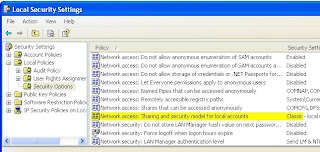
Monday, February 02, 2009
ActiveDirectory Recovery Note
Since the time of Windows NT, I really disliked the Domain Controller architecture in Microsoft network. The part that I really did not like about it is that it basically required two dedicated machines to handle this, and we are not supposed to install anything else on it, for example SQL server (you can, and I strongly advise you against doing this. Some day you run into trouble and it will cost you several times over the cost of the hardware you thought you saved.) In addition they had the idea of Primary and Backup domain controllers with the notion of the backup controller a bit dubious since if you lost the primary, you probably lost the ability to get back the primary easily.
When Windows 2000 came out I was a bit excited to be told about the fact that the AD does not have the notion of the Primary and Backup. But soon enough that was not true, and in fact it got even more complicated.
This was now 2008, in my small office, I had a brilliant idea of hosting two AD servers on virtual machines since we don't really maintain any more than a few user names and such. Well, however, we've just lost one of the controllers during a VM migration completely, so I had to basically create another one from the remaining "backup" controllers.
This has caused a several hours of "wasted time," since I really don't want delve into this AD stuff. So if this happens again here is the note to myself. Things like a backup fail-over should be basically instantaneous and I expect there ought to be one-button thingy for basically an idiotic (by choice) user by me, but this not being like that does protect lot of jobs in the industry I would guess.
When Windows 2000 came out I was a bit excited to be told about the fact that the AD does not have the notion of the Primary and Backup. But soon enough that was not true, and in fact it got even more complicated.
This was now 2008, in my small office, I had a brilliant idea of hosting two AD servers on virtual machines since we don't really maintain any more than a few user names and such. Well, however, we've just lost one of the controllers during a VM migration completely, so I had to basically create another one from the remaining "backup" controllers.
This has caused a several hours of "wasted time," since I really don't want delve into this AD stuff. So if this happens again here is the note to myself. Things like a backup fail-over should be basically instantaneous and I expect there ought to be one-button thingy for basically an idiotic (by choice) user by me, but this not being like that does protect lot of jobs in the industry I would guess.
- It seems to work better if you'd install the DNS first before adding the domain controller role.
- Download the Windows Support Tool from the MS web site. This has two important tools . One is called NETDIAG and another is DCDIAG. These are command line tools and if you run them without any argument they will tell you in more gory details about what's wrong with your DNS and Domain Controller settings. Basically they run a series of tests and they will return either pass or fail. The idea is to fix things so that they will all Pass. For each Fail, type in the error message into Google (not Live Search) and you will find the answer article on how to fix things on Microsoft web site. (Message to MS - Please improve the search on your own product related information.) I would fix the DNS first.
- Next tool you will need to use is NTDSUTIL program. You use this tool to basically transfer some of the critical roles that your lost domain controller had. The terminology you need to use to search is "Seize [blah blah] role" And you basically issue the Seize command to this tool. There are about 4 or 5 roles that you need to Seize, and one additional tricky thing is the "Infrastructure" role. This apparently should not be seized by the primary, so run the same tool on the secondary server and have it seize the "Infrastructure" role.
Monday, December 01, 2008
How To Nissan Key Fob Battery Replacement. 2005 Model year. Key-less system. What Battery To Buy
Symptom:
Want to replace a battery in Nissan Key Fob.
Battery:
The battery is CR2025, pretty standard. It is $15.00 at car dealership.
Replacement:
Pull the metal key out and there is a notch in the middle. With a small flat screw driver head apply a small pressure and then pull up the cover from the screw drive end while the pressure is being applied. It opens up quite easily.
Comment:
Sorry nothing to do with the regular IT article, but I just need to jot down the battery model if we need to do it again.
Subscribe to:
Posts (Atom)